

Iran PVC Exports Buyer Guide to Resin Grades Quality and Reliable Sourcing
Iran PVC Exports Buyer Guide to Resin Grades Quality and Reliable Sourcing
A buyer focused starting point
PVC looks straightforward on a quotation, yet a grade name and price per tonne rarely define the material. A suspension resin that performs well in pressure pipe may be unsuitable for cable insulation. Paste resin for synthetic leather behaves differently from general-purpose powder, and products with a similar K-value can still differ in porosity, particle distribution and fusion.
For an international buyer, the useful question is therefore not simply, “What is the price of Iranian PVC?” It is, “Which resin or compound fits my process, what evidence supports the specification, and can the supplier deliver the same result from one lot to the next?”
This guide covers PVC families, HS codes, Iran trade statistics, quality tests, regulation and sourcing for buyers considering Iran PVC exports.
Why PVC remains a major traded polymer
Polyvinyl chloride is widely used because it can be formulated as a rigid or flexible material. Rigid PVC appears in pipes, fittings, window profiles, conduit and sheets. Plasticised PVC is used in cable compounds, flooring, coated fabrics, hoses and footwear.
Resin is only the starting point. Stabilisers, plasticisers, lubricants, fillers and processing aids determine how a formulation behaves, so virgin resin and ready-to-process compound require different specifications.
In 2024, the United States reported HS 390410 exports worth US$2.543 billion and 3.112 million tonnes, while China reported US$1.978 billion and 2.725 million tonnes. India was the largest reported importer at US$2.590 billion.[1] Iranian supply should therefore be compared on usable cost, consistency, documentation and route, not headline price alone.
Know which PVC family you are buying
The end product and conversion process should drive grade selection. The descriptions below are indicative; the producer’s current data sheet and an approved trial are the final references.
| PVC family | Typical form and behaviour | Common applications | What the buyer should confirm |
| Suspension PVC or S PVC | Free-flowing porous powder and the main general-purpose PVC resin | Pressure and drainage pipe profiles cable compounds rigid sheet bottles and fittings | K-value viscosity particle size apparent density porosity volatiles contamination and residual VCM |
| Emulsion PVC or E PVC | Fine powder designed to form plastisols or pastes with plasticiser | Synthetic leather flooring wall coverings gloves coated fabric sealants and underbody coatings | Paste viscosity ageing behaviour particle size foam response gelation and surface finish |
| Bulk or mass PVC | Resin made without the normal suspension medium and often selected for particular clarity or processing needs | Transparent and specialised rigid products depending on grade | Producer process grade identity fusion behaviour and approved application |
| Rigid PVC compound or PVC U | Non-plasticised dry blend powder or granules containing stabilisers lubricants fillers and other additives | Pipe fittings window profiles conduit siding and rigid sheet | Complete formulation regulatory status colour impact strength Vicat performance and processing window |
| Flexible PVC compound or PVC P | Plasticised compound supplied as granules or dry blend | Cable insulation and sheathing hoses footwear flooring seals and flexible profiles | Plasticiser identity hardness tensile properties low-temperature performance flame behaviour and migration limits |
| Chlorinated PVC or CPVC | Chemically modified PVC with higher chlorine content and improved temperature resistance | Hot-water pipe industrial piping valves and specialised sheet | Exact polymer identity relevant approvals compound design and customs classification |
K-value describes viscosity and the approximate molecular-mass range of PVC resin. Lower-K materials generally process more easily, middle ranges are common in profiles and pipe, and higher-K resins may be selected for greater mechanical performance. These are tendencies, not universal rules. ISO 1628-2:2020 warns that K-values are comparable only when test conditions are consistent.[2]
For compound, ask for the formulation purpose and limits. “PVC compound” does not identify the stabiliser, plasticiser, filler or recycled content, all of which affect processing and regulation.
PVC HS codes for import and export
The World Customs Organization places PVC and related vinyl chloride polymers in heading 3904 when supplied as liquids, pastes, powders, granules or other primary forms.[3]
| HS code | International description | Practical trade note |
| 390410 | Polyvinyl chloride not mixed with other substances | Common code for virgin PVC resin powder including many suspension or emulsion grades |
| 390421 | Other PVC non-plasticised | Often relevant to mixed rigid PVC in primary form subject to composition and national rules |
| 390422 | Other PVC plasticised | Common for plasticised PVC compounds in primary form |
| 390430 | Vinyl chloride vinyl acetate copolymers | Used for the specifically described copolymer |
| 390440 | Other vinyl chloride copolymers | Applies when the composition meets this subheading rather than PVC homopolymer rules |
| 390490 | Other polymers of vinyl chloride or other halogenated olefins | May cover certain materials not described by the preceding subheadings including some chemically modified products |
Finished products use other headings, including 391620 for PVC profiles, 391723 for rigid vinyl-chloride polymer pipes and 391810 for PVC floor coverings. National tariffs add digits and may change duties or controls, so confirm classification before fixing a landed price.
Iran PVC production context
Iran has produced PVC since 1970 and now operates a wider petrochemical and polymer base. The official Iran Plast 2025 publication reported actual national polymer production of 6.96 million tonnes in the Iranian year 1403, broadly March 2024 to March 2025, against nominal capacity of 9 million tonnes. It also referred to 26 polymer projects and a target of 16 million tonnes of polymer capacity by 1407, or 2028 to 2029.[4]
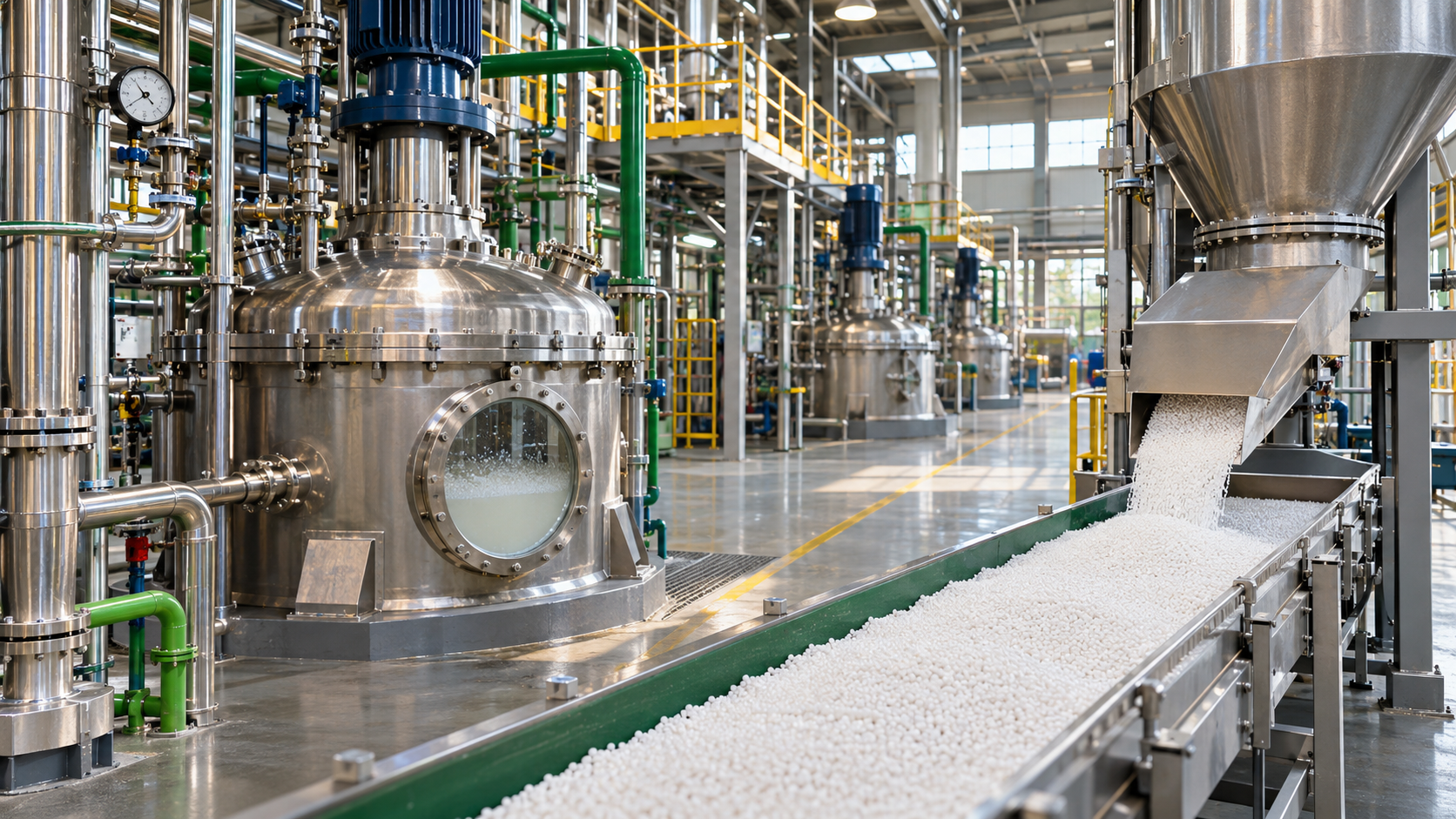
Nameplate capacity should not be confused with current output. Arvand’s complex was designed for 340,000 tonnes a year of PVC, including 300,000 tonnes of suspension resin and 40,000 tonnes of emulsion resin.[5] Ghadir lists 120,000 tonnes and Abadan 122,000 tonnes.[6][7] Maintenance, feedstock, domestic allocation and grade campaigns change monthly availability.
A serious enquiry should name the producer and grade. Also establish whether the seller is the manufacturer, an authorised marketer, a distributor or an independent trader, because each position requires different evidence.
What the trade data says and what it does not say
World Bank WITS data sourced from UN Comtrade provides a market map. Iran’s reported 2023 flows show that resin and compound trade can move in different directions.
| Trade flow and product | 2023 value | 2023 quantity | Main reported partners |
| Exports HS 390410 PVC not mixed | US$9.243 million | 10,403.50 tonnes | Iraq Afghanistan Pakistan Azerbaijan and Turkmenistan |
| Imports HS 390410 PVC not mixed | US$21.044 million | 13,673.40 tonnes | United Arab Emirates China Germany Turkiye and Republic of Korea |
| Exports HS 390422 plasticised PVC mixed | US$57.404 million | 53,554.00 tonnes | Iraq Afghanistan Uzbekistan Pakistan and Tajikistan |
| Imports HS 390422 plasticised PVC mixed | US$2.865 million | 927.88 tonnes | Turkiye China Bulgaria Spain and Republic of Korea |
| Imports HS 390421 non-plasticised PVC mixed | US$0.943 million | 495.03 tonnes | China Hong Kong China Spain Turkiye and Germany |
For HS 390410 exports, Iran reported Iraq at US$6.354 million and 7,099.06 tonnes and Afghanistan at US$1.959 million and 2,296.73 tonnes.[8] Under HS 390422, Iraq accounted for US$36.971 million and 34,036.70 tonnes, followed by Afghanistan at US$6.775 million and 6,054.49 tonnes.[9]
Mirror data for 2024 differs. Importers reported HS 390410 purchases led by Kazakhstan at US$1.954 million and 3,466.20 tonnes, Iraq at US$0.511 million and 528.06 tonnes and Armenia at US$0.491 million and 483.30 tonnes.[10] For HS 390422, Azerbaijan reported US$3.261 million and 3,621.51 tonnes, followed by Uzbekistan and Turkiye.[11]
Do not combine the 2023 reporter figures with 2024 mirror data or calculate a growth rate from them. Coverage, valuation, routing, timing and classification differ. The figures confirm trade, not live grade availability.
Build an RFQ that produces comparable offers
“Need 500 tonnes PVC best price” invites mismatched quotations. Provide enough information for the supplier to propose and justify a grade.
- Finished product: pressure pipe, drainage pipe, window profile, cable insulation, synthetic leather, flooring, hose, rigid sheet or another defined article.
2. Conversion process: twin-screw extrusion, injection moulding, calendaring, coating, rotational moulding or plastisol processing.
3. Material required: virgin S PVC, E PVC, PVC U compound, PVC P compound, CPVC or an approved equivalent.
4. Critical values: K-value or viscosity number with test method, apparent density, particle distribution, volatiles, plasticiser absorption, residual VCM and contamination limit.
5. Formulation rules: permitted stabiliser and plasticiser systems, filler limit, recycled-content policy, colour and additive restrictions.
6. Regulated use: drinking water, food contact, medical, toys, cable, construction or general industrial use, including the destination standard.
7. Commercial terms: trial quantity, monthly volume, contract period, packaging, destination, delivery window, Incoterm and proposed payment route.
8. Evidence: current TDS, SDS, recent lot COA, origin document, producer confirmation, compliance declaration, sample and inspection requirement.
The buyer should explain the process and limits; the supplier should identify a grade and provide evidence. If the response is only “same as requested,” run a representative production trial before committing to volume.

Quality tests that protect the buyer
A data sheet reports typical values. A certificate of analysis should identify the lot and report actual results against agreed limits. Buyers normally need both, plus the SDS and application-specific declarations.
For PVC resin, the following checks are commercially useful:
- K-value or viscosity number under ISO 1628-2 or an agreed ASTM method such as ASTM D1243;
• apparent density under ISO 60 and particle-size distribution under ISO 4610;
• volatile matter including water under ISO 1269;
• residual vinyl chloride monomer under ISO 6401:2022;
• plasticiser absorption under ISO 4608:2023 or ISO 4574:2019 where relevant;
• impurity count, black specks, whiteness, porosity, fish-eyes and thermal stability as required by the end product;
• lot number, production date, test method, result, specification limit and authorised signature on the COA.
PVC is sensitive to heat history, contamination and formulation changes. Test a new source in the normal formulation and production line, checking fusion, output, surface finish, colour, scrap and finished-product performance. Retain a sealed reference sample where practical.
ISO 1452 covers PVC U piping for water supply and pressure drainage, but resin with a suitable K-value does not by itself certify the finished pipe.[12]

Regulatory evidence must match the application
“Food grade,” “REACH compliant” and “lead free” are incomplete without a grade, formulation, destination and intended use.
For EU food contact, Regulation EU No 10/2011 controls substances, migration, testing and documentation. The text current to 14 July 2026 sets an overall migration limit of 10 mg per square decimetre for most applications.[13] In the United States, FDA listings still require the buyer to confirm the applicable authorisation and conditions for every formulation component.[14]
Flexible PVC requires careful review of plasticisers. EU REACH restricts DEHP, DBP, BBP and DIBP in a wide range of articles at a combined or individual concentration of 0.1 percent or more by weight of plasticised material, subject to the detailed scope and exemptions.[15] EU Regulation 2023/923 also restricts lead in PVC material at 0.1 percent by weight or more from 29 November 2024, with defined derogations and marking rules for certain recovered rigid PVC applications.[16]
Drinking-water, medical, toy, cable and construction products have additional rules. Request evidence for the exact producer, grade, formulation and site; a certificate for another compound is not enough.
Price logistics and usable landed cost
PVC prices respond to ethylene, chlorine, EDC and VCM economics, energy, plant operating rates, domestic demand, grade campaigns and regional freight. Iranian offers are also shaped by producer allocation, order size, packaging, inland transport, export procedures, inspection and payment structure.
Compare quotations on the same Incoterm and specification:
Material price plus inland transport plus terminal and documentation charges plus freight plus insurance plus duty and taxes plus finance and compliance cost plus expected processing loss
Low-priced resin becomes expensive if it reduces output, creates fish-eyes or plate-out, changes colour or raises scrap.
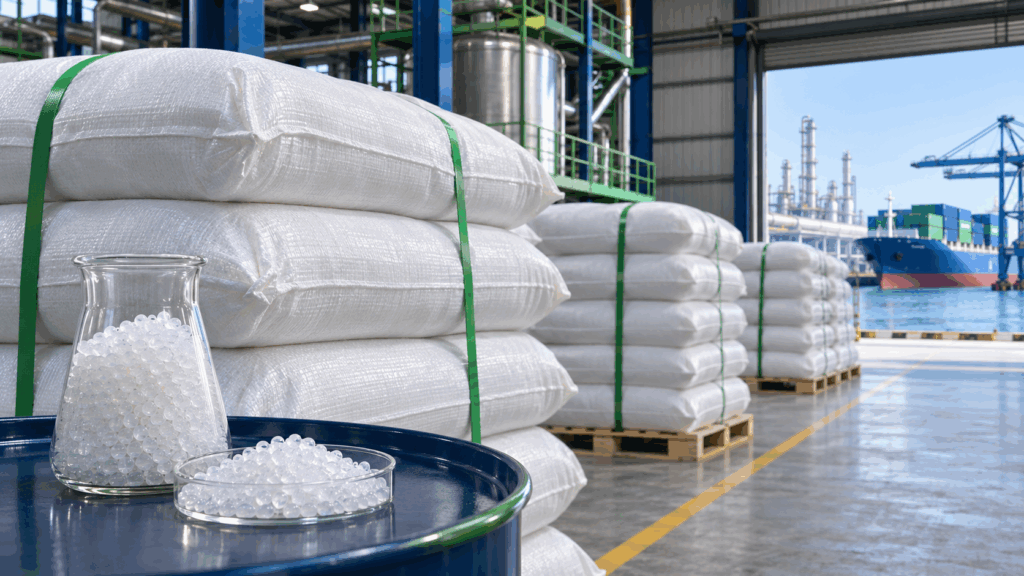
PVC resin is commonly shipped in 25 kg bags or larger flexible containers. Confirm net weight, bag construction, pallet or sling arrangement, moisture protection, lot separation and markings. Inspect the container for water, residue and sharp surfaces before loading.
Where pellet-loss rules apply, plan for containment and spills. EU Regulation 2025/2365 introduces phased obligations, while IMO recommendations address packaging, cargo information and protected stowage.[17][18]
Trade compliance and supply continuity in 2026
Iranian export rules and international sanctions can change faster than a normal procurement cycle. Iran introduced emergency restrictions on chemical, polymer and petrochemical exports in April 2026. The Trade Promotion Organization later instructed customs to remove the restriction after its legal period expired, with the lifting reported effective 12 July 2026 under reference 8105594, subject to the normal rules.[19]
Screen the producer, seller, payment beneficiary, banks, insurers, vessels, ports, end user and goods under every jurisdiction involved. OFAC continued to publish Iran-related notices in October 2026, so reuse of an old compliance opinion is risky.[20] Obtain advice for the proposed route.
Define the approved producer and grade, substitution process, shipment window, inspection point and response to regulatory delay. Qualify an alternative grade in advance where possible.
How to verify an Iranian PVC offer
Start with the seller’s legal identity and authority to supply the named producer’s product. Confirm the manufacturing site, exact grade code, available lot, packaging and allocation evidence. Match the pro forma invoice with the contract, bank beneficiary, origin, quantity and Incoterm.
Warning signs include an unexplained low price, refusal to name the producer, a COA without a lot number, inconsistent grade codes, payment to an unrelated company and a last-minute “equivalent” substitute. Ask which tests establish equivalence.
Independent inspection can verify bag markings, lot identity, quantity, container condition and sampling. It cannot turn an unsuitable grade into the correct one, so technical approval must come first.
Looking for Iranian Polypropylene manufacturers? Get access to manufacturer contacts and business opportunities through Ixport’s NEXUS B2B Directory.
From market research to a workable sourcing plan
IXPORT helps foreign buyers turn market information into a verifiable sourcing process. NEXUS by IXPORT identifies companies in chemical, plastic, polymer and rubber industries. Iran Gateway supports local research, supplier verification, inspection, document control and representation.[21][22]
The first message can be brief but specific. Send IXPORT your end product, process, required PVC family, target K-value, critical test limits, monthly quantity, destination and preferred delivery term. That information makes it possible to build a shortlist around technical and commercial fit instead of sending a generic list of traders.
Iran can be a useful PVC source when the grade works in the buyer’s process, documents match the lot, the route is lawful and both parties agree how to manage specification or delivery changes.
Sources
- World Bank WITS using UN Comtrade data, global HS 390410 exports and imports in 2024: Read source and Read source
2. ISO 1628-2:2020, K-value and reduced viscosity of PVC resins: Read source
3. World Customs Organization, HS Nomenclature 2022, Chapter 39: Read source
4. Iran Plast 2025 official publication, National Petrochemical Company message: Read source
5. Thyssenkrupp Uhde, Arvand PVC complex capacities: Read source6. Ghadir Petrochemical complex capacity: Read source
7. Abadan Petrochemical complex capacity: Read source
8. World Bank WITS using UN Comtrade, Iran HS 390410 trade in 2023: Read source and Read source
9. World Bank WITS using UN Comtrade, Iran HS 390422 trade in 2023: Read source and Read source
10. World Bank WITS mirror data, HS 390410 imports from Iran in 2024: Read source11. World Bank WITS mirror data, HS 390422 imports from Iran in 2024: Read source
12. ISO 1452, PVC U piping systems: Read source and Read source
13. EUR-Lex, Regulation EU No 10/2011 consolidated to 14 July 2026: Read source
14. United States FDA, PVC food-contact inventory and regulatory status guidance: Read source and Read source
15. European Chemicals Agency, phthalate restrictions: Read source
16. EUR-Lex, Regulation EU 2023/923 on lead in PVC: Read source
17. EUR-Lex, Regulation EU 2025/2365 on plastic pellet losses: Read source
18. International Maritime Organization, plastic pellet transport recommendations and 2026 code development: Read source
19. Iran polymer export restriction update, reference 8105594 effective 12 July 2026: Read source
20. United States Treasury OFAC, Iran sanctions programme: Read source21. IXPORT NEXUS B2B : Read source
22. IXPORT Iran Gateway: Read source
Comments