

Buying Steel Slabs from Iran with Confidence
Buying Steel Slabs from Iran with Confidence
Buying steel slabs from Iran starts with matching the material to your mill’s requirements, from steel chemistry and slab dimensions to quality documentation and delivery conditions. A slab purchase begins long before a vessel is booked. It begins with the coil or plate your customer expects, the dimensions your mill can process and the quality you need after rolling. When those requirements are clear, supplier discussions become much more productive.
Iran steel slab exports offer a market worth investigating for overseas rerollers and trading companies. The commercial question is whether a particular producer can supply the right material, with the necessary documentation and a feasible delivery arrangement. This guide helps you assess that fit, from product selection and historical trade data to the details that make an inquiry useful.
What a steel slab becomes
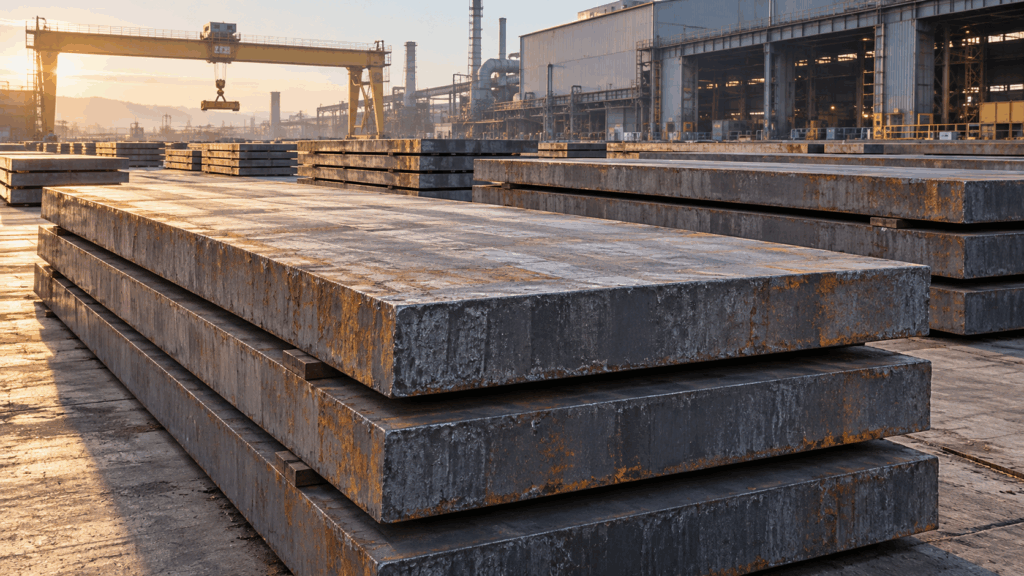
A steel slab is a rectangular semi-finished product used to make flat steel, including hot-rolled coil and plate. Worldsteel distinguishes slabs from billets, which feed products such as bars and wire rod. [1]
For buyers, the distinction is practical. A slab’s width, thickness and metallurgical condition must work with the receiving mill. Downstream products may undergo further cold rolling, coating or fabrication, so requirements can extend well beyond the first rolling operation.
Tell a prospective supplier what you plan to manufacture. “Slab for general rolling” gives far less direction than a description of the intended coil, plate or subsequent application. It also makes it harder for the supplier to identify an unsuitable offer early.
Slab types and product families
Consider two separate classifications: the casting format and the steel family. A thicker slab is not automatically a higher grade, and matching dimensions does not establish chemical suitability.
Conventional thin and heavy slab formats
Conventional slabs supply hot-strip and plate production routes. Thin-slab casting can form part of an integrated casting-and-rolling system, such as the Arvedi ESP process described by Primetals Technologies. Thin slabs should therefore not be assumed interchangeable with conventional merchant feedstock. [2]
Heavy and ultra-thick slabs serve particular plate-production requirements. Primetals describes casting technology capable of thicknesses up to 460 mm; this illustrates a global technology capability, not an Iranian supplier’s available range. [3]
Ask the receiving mill to approve the proposed format. Furnace dimensions, handling capacity and the rolling schedule matter more than a broad label such as “standard slab.”
Carbon alloy and stainless categories
Your sourcing brief should distinguish ordinary carbon steel from low-alloy, other alloy and stainless requirements. Within those families, the intended application determines the chemistry, processing route and qualification work.
| Intended downstream product | Questions for technical qualification |
| General hot-rolled coil | Can the chemistry, dimensions and surface condition meet the rolling specification? |
| Structural plate | What strength, toughness and processing requirements must the slab support? |
| Sheet for forming | What cleanliness, chemistry and surface requirements apply through subsequent processing? |
| Plate or coil for pipe production | What weldability and internal-quality requirements does the purchaser specify? |
| Stainless or specialist alloy flat products | Can the source meet the exact alloy composition and processing requirements? |
These are purchasing categories, not claims that every Iranian mill produces each grade. A producer’s caster portfolio can include several steel families, but availability and qualification must be established for the actual order. [4]
Iran slab export statistics
The Iranian Steel Producers Association’s ten-month 1404 table, published by Chilan on 14 February 2026, reports the following slab figures. The period runs approximately from March 2025 to January 2026. [5]Iran export statistics
| Slab export measure | Ten months of 1403 | Ten months of 1404 |
| Volume | 1.311 million tonnes | 1.764 million tonnes |
| Value | US$588 million | US$704 million |
The source reports volume growth of 35% and value growth of 20%, rounded. Slab accounted for approximately 26.4% of the reported 6.689 million tonnes of semi-finished exports in the latter period, calculated by IXPORT from those figures. [5]
The slower increase in value than volume is a reason to examine product mix and commercial conditions before drawing conclusions about prices. Aggregate trade values are not quotations for a particular grade, shipment date or destination.
Slab imports into Iran
ISPA’s separate eight-month 1404 table reports slab imports of 0.21 thousand tonnes, equivalent to approximately 210 tonnes, with a displayed value of US$0.2 million. That is a different reporting period and should not be used against the ten-month export total to calculate a trade balance. [6]
For foreign suppliers, this historical figure points to a small recorded import segment. It does not identify the grades purchased or establish current demand. Begin with a named industrial requirement before building a sales forecast. Iran gateway
Work backwards from the final specification
A finished-product grade tells you what the customer ultimately needs. The slab purchase specification must explain what the receiving mill needs to achieve it.
Have your metallurgical team define the chemical limits, including relevant residual and microalloying elements. Agree which heat-analysis results must appear on the mill certificate and whether additional product analysis is required.
For demanding applications, discuss the steelmaking and secondary-metallurgy route, inclusion control and any required evidence of prior qualification. Do not treat a familiar grade name as proof that two suppliers’ slabs will behave identically in your mill.
Some steels are particularly sensitive to casting conditions. Primetals identifies peritectic, microalloyed and advanced high-strength grades among applications where cooling control affects surface quality. The purchasing implication is to ask how the offered material’s quality is demonstrated, rather than relying solely on the grade label. [7]
Which finished-product requirement would cause your customer to reject a delivery? Make sure the slab qualification plan addresses it.
Specify geometry and piece weight together
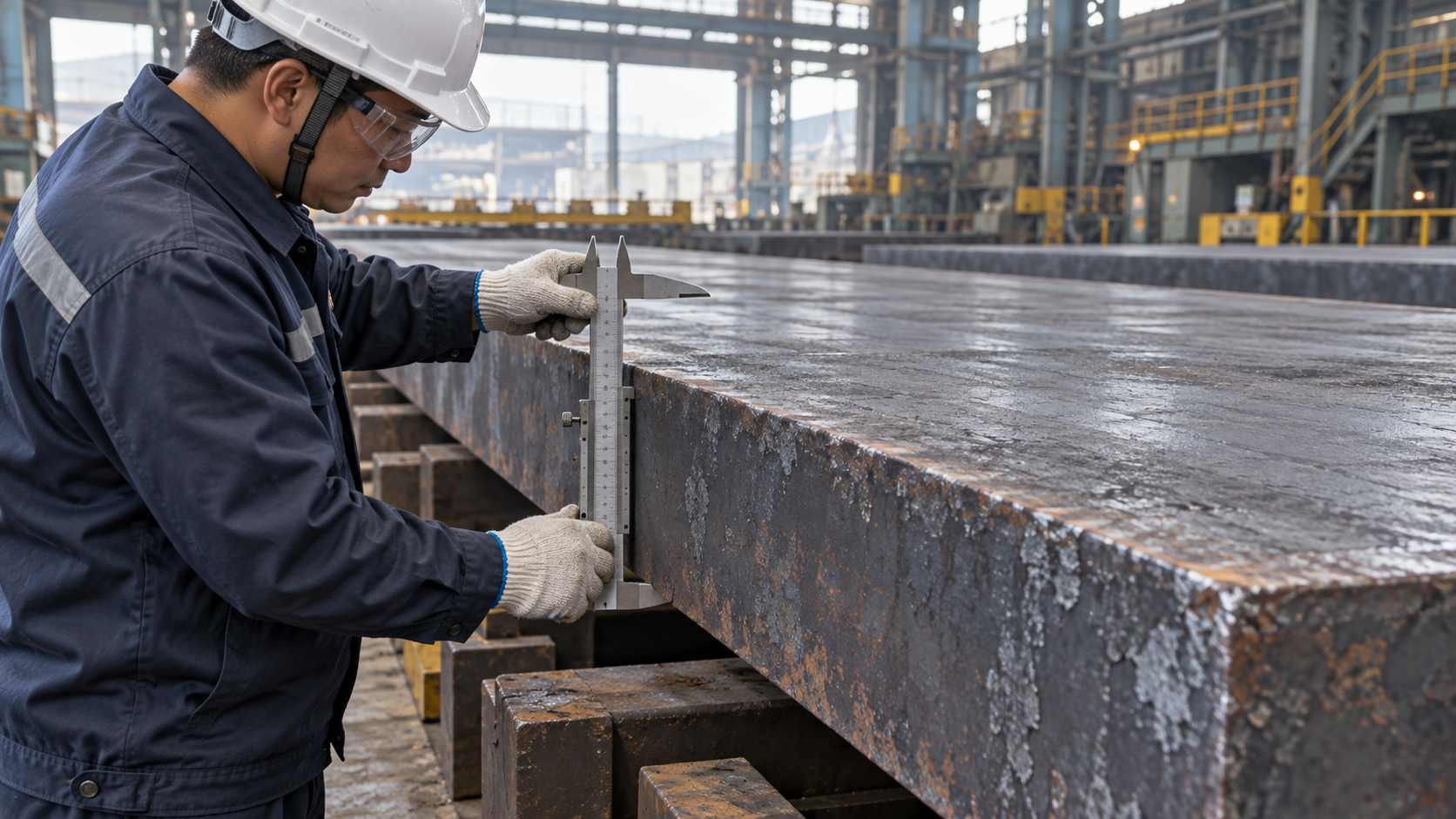
An order should state thickness, width, length, tolerances and acceptable shape. Include the mill’s requirements for flatness or bow, edge condition, cut ends and any surface conditioning.
Piece weight deserves its own check. As a hypothetical planning example, a slab measuring 250 mm × 1,500 mm × 9,000 mm has a volume of 3.375 cubic metres. Using an assumed density of 7.85 tonnes per cubic metre gives approximately 26.49 tonnes per piece.
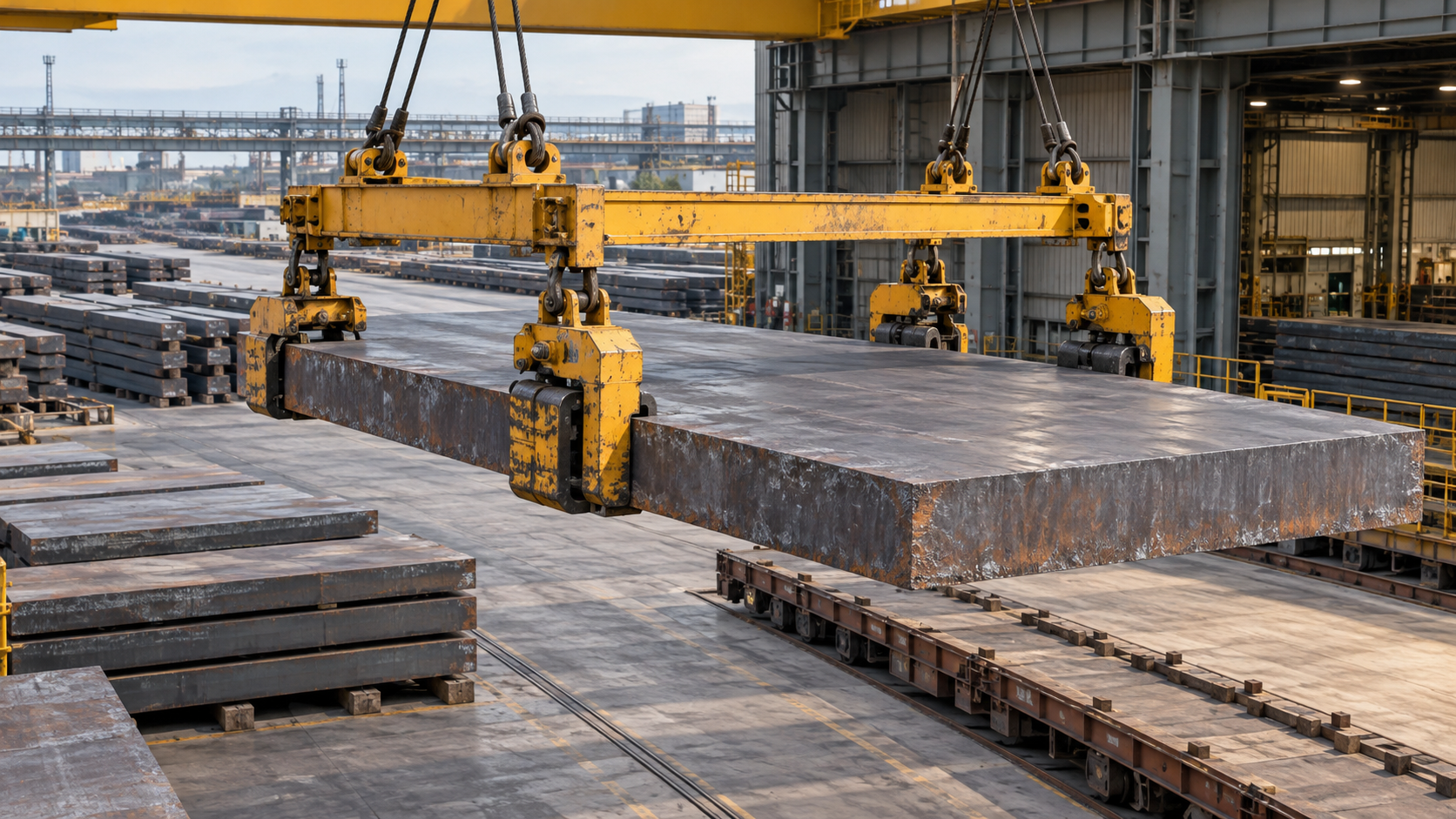
That is an estimate, not a settlement weight or an advertised Iranian product size. Actual dimensions, composition and the agreed weighing method govern the transaction. Nevertheless, a calculation at inquiry stage can reveal whether the proposed format exceeds a crane, truck or receiving-area limit.
Ask the supplier and logistics provider to confirm handling feasibility before you agree the final length. A commercially attractive format can become expensive if it requires avoidable cutting or special handling.
Check surface quality and internal soundness
Surface photographs are useful, but they cannot establish internal quality. Slab casting involves solidification control, and technology suppliers identify centre segregation and porosity as quality concerns addressed through casting processes. [3]
Define which defects are unacceptable, how they will be assessed and what conditioning is permitted. If scarfing or grinding is proposed, agree the resulting dimensional limits and acceptance criteria.
Where the application requires internal examination, your technical team should choose an appropriate method, sampling plan and test stage. A vague request for “ultrasonic quality” leaves too much unresolved: specify what will be examined and how acceptance will be decided.
Maintain traceability from heat and slab identification through inspection, shipping and the receiving mill’s production records. This becomes particularly important if a problem appears only after rolling. The claim should be traceable to material and processing evidence rather than a general complaint about the shipment.
Make the rolling trial answer a commercial question
For a new source, agree a trial programme that your mill can evaluate meaningfully. Define the product to be rolled, the operating conditions to record and the acceptance decision before the material arrives.
Record conditioning work, crop and trim losses, production interruptions and finished-product results. Review those findings with the supplier, including what worked well. This gives both sides a basis for adjusting the specification or planning repeat business.
Avoid judging an entire supplier on an unrepresentative sample, or approving unlimited future production after one successful heat. Qualification should have a defined scope, with an agreed process for changes in grade, dimensions or manufacturing route.
Compare the cost of the finished rolling programme
A slab quotation is one component of the economics. Include freight, handling, inspection, conditioning, financing, destination charges and the mill’s expected conversion costs when comparing offers.
Also look at the width plan. Buying a width poorly matched to your order book can create unnecessary trimming or limit which finished sizes you can produce. Ask production planning to compare candidate slab sizes against actual customer orders.
Separate confirmed costs from assumptions. Show the quotation validity, exchange-rate basis, freight validity and expected delivery window on the comparison sheet. If the order depends on a future vessel or production campaign, record that dependency instead of treating it as a confirmed commitment.
The useful question is whether the proposed supply supports a profitable, deliverable rolling programme at an acceptable level of uncertainty.
For repeat purchases, discuss how different widths and grades will be grouped into production and shipping lots. Ask whether a change in your order mix affects lead time, minimum quantity or price. Keep forecasts separate from firm orders, and agree when each requirement becomes binding. This helps your mill plan inventory without assuming that every requested combination is immediately available.
Classify the product before calculating duties
For steel slab import and export, composition affects customs classification. WCO Chapter 72 distinguishes these headings. [8]
| Slab material | Indicative HS heading |
| Iron or non-alloy steel semi-finished products | 7207 |
| Stainless steel semi-finished products | 7218 |
| Other alloy steel semi-finished products | 7224 |
These are four-digit headings, not final national tariff codes. Ask the customs broker to confirm the full code and applicable duties, origin rules and trade measures for the destination. Carbon content and geometry can affect classification below heading level. Avoid applying one “steel slab import duty” to every product.
Confirm export conditions and transaction feasibility
Export rules can change between market research and shipment. Chilan reported a temporary Iranian slab and sheet export restriction in April 2026, followed by a June report quoting the ministry’s confirmation that the restriction had ended. These dated reports show a policy change, not blanket clearance for a new shipment. [9]
Separately, OFAC guidance on Executive Order 13871 identifies sanctions authorities concerning Iran’s iron and steel sectors and certain significant transactions and financial activity. Non-US businesses can also face exposure. [10]
Obtain qualified review of the parties, ownership, goods, end use, destination, transport and payment arrangements. Confirm any required authorizations and bank, insurer and carrier acceptance before placing a deposit. Agree how the contract handles an inability to obtain necessary approvals or complete shipment.
Find a counterpart who understands your application
For an overseas plate or hot-strip mill, the search begins with a technically suitable source. For a foreign slab supplier approaching Iran, it begins with identifying a customer whose requirement your material can meet.
IXPORT’s Nexus B2B includes a steel category that can help you assemble an initial company shortlist. Verify each contact’s current role and capabilities; a listing alone does not establish that the company produces slabs or purchases your grade. [11]
If your goal is to present an industrial offering to Iranian customers, Iran Gateway provides a Persian-language company presence and a channel for cooperation inquiries. Explain your applications, available documentation and technical support so a prospective customer can assess relevance. [12]
Tell us what you are working toward: sourcing slab, qualifying a second supplier or exploring sales into Iran. The more specific your starting point, the more useful the conversation.
Send an inquiry the supplier can evaluate
Include your finished-product application, slab specification, chemistry, dimensions, piece-weight limits, quantity and delivery window. Add inspection requirements, destination and preferred delivery basis. Identify which requirements are mandatory and invite the seller to state deviations clearly.
If you are still exploring, start with one question: what information would allow your technical or purchasing team to make the next decision? Share that question with IXPORT alongside your company’s role in the supply chain.
Sources and editorial evidence
1. World Steel Association, Glossary, slab and billet definitions. Read source
2. Primetals Technologies, Arvedi ESP, thin-slab casting and rolling process. Read source
3. Primetals Technologies, Transforming Heavy Plate Production with Ultra Thick Slab Casting. Technology context only, not evidence of Iranian mill capability. Read source
4. Primetals Technologies, additional continuous slab caster for HBIS Laoting, illustrating grade families. Read source
5. Iranian Steel Producers Association, ten-month 1404 export table, published by Chilan on 14 February 2026. Original units: thousand tonnes and US$ million. Slab volume 1403/1404: 1,311/1,764; value: 588/704. Total semi-finished volume 1404: 6,689. Source rounding retained. Read source
6. Iranian Steel Producers Association, eight-month 1404 import table, published by Chilan on 20 December 2025. Slab: 0.21 thousand tonnes and US$0.2 million. Values are rounded and this period differs from the export table. Read source
7. Primetals Technologies, Dry Casting, grade-sensitive cooling and surface quality. Read source
8. World Customs Organization, HS 2022, Chapter 72. Read source
9. Chilan, restriction announcement, 27 April 2026, and report of its ending, 6 June 2026, quoting ministry correspondence. Current transaction clearance still requires confirmation. Read source ; Read source
10. US Treasury, OFAC FAQ 666, Executive Order 13871. Read source
11. IXPORT, Nexus B2b. Read source
12. IXPORT, Iran Gateway. Read source
Comments