

Iran Polyethylene Exports A Buyers Guide to Grades Quality and Reliable Sourcing
Iran Polyethylene Exports A Buyers Guide to Grades Quality and Reliable Sourcing
Buying polyethylene starts with the application
A buyer rarely needs “polyethylene” in the general sense. They need a resin that will run properly on a particular machine and produce a film, pipe, bottle, cap, cable coating or moulded part with predictable performance.
That distinction matters when sourcing from Iran. The country is a large exporter of polyethylene in primary forms, but the market includes many grades with different densities, melt-flow rates, molecular structures and additive packages. Two products may both be described as HDPE and still behave very differently in a blow-moulding line or pipe extrusion process.
This guide looks at Iran polyethylene exports from a buyer’s point of view. It explains the main polyethylene families, HS codes, recent trade figures, important destination markets, quality documents, inspection points, logistics and the information an Iranian supplier needs before it can prepare a meaningful offer.
If you are an importer, converter, distributor or industrial manufacturer, the goal is simple: move from asking “What polyethylene do you have?” to asking for the grade that fits your process, product and market.
One polymer family with very different grades
Polyethylene is made by polymerizing ethylene, but changes in molecular structure create materials with quite different properties. Density is a useful first dividing line, although it does not tell the whole story.
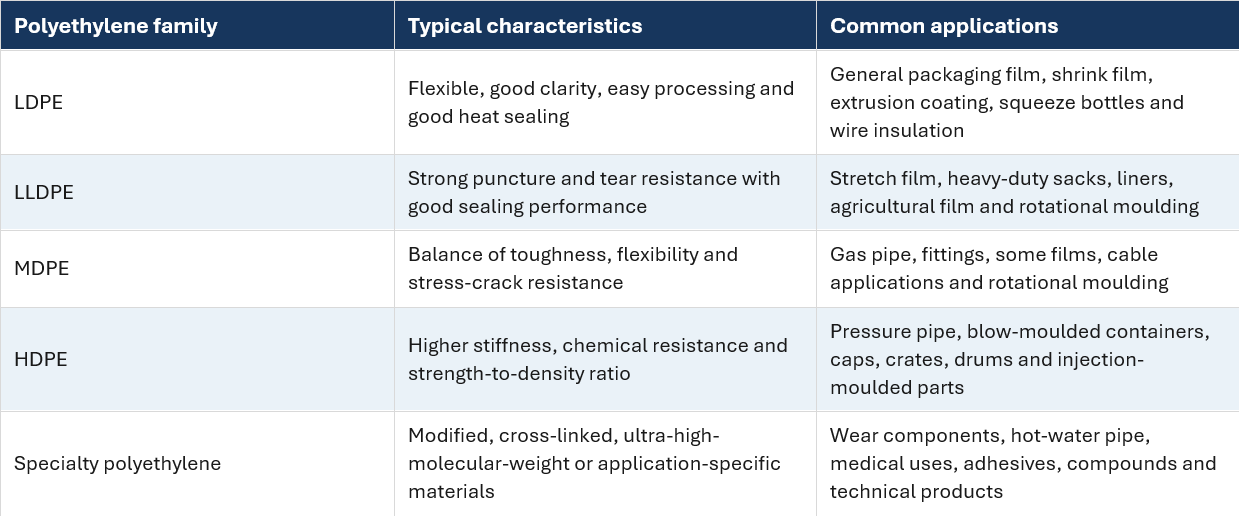
The density ranges of these families overlap, and commercial names are not a substitute for a grade specification. LLDPE film resin, for example, may differ by comonomer, molecular-weight distribution, slip and antiblock package. HDPE pipe material must be judged by long-term pressure performance and compound requirements, not simply by density.
Before discussing price, tell the supplier how the material will be processed and what the finished product must do.
Understanding the HS codes
Most international trade in polyethylene resin is reported under HS heading 3901, which covers polymers of ethylene in primary forms. The two largest Iranian export lines are separated by specific gravity:
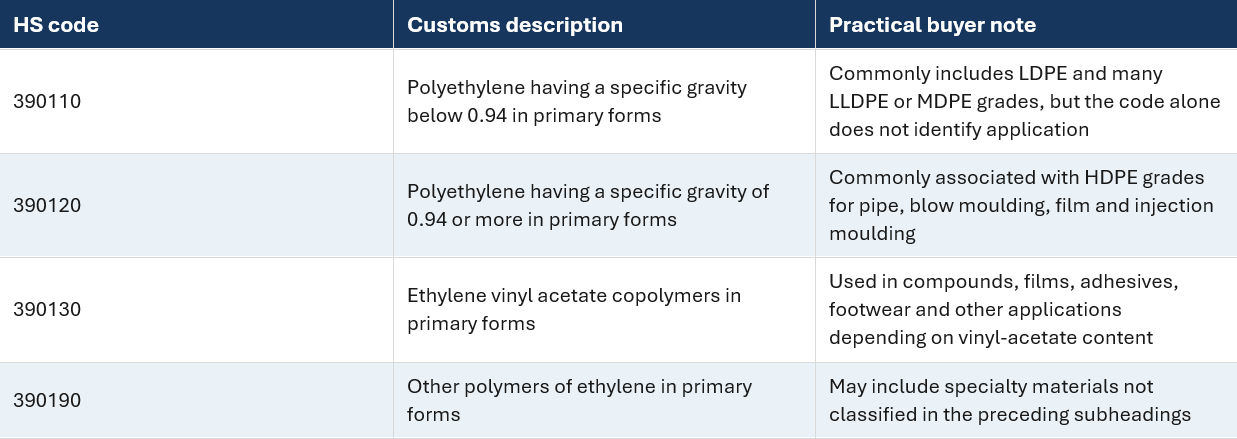
Newer HS nomenclatures also include code 390140 for certain ethylene-alpha-olefin copolymers below 0.94 specific gravity. Always confirm which HS version your customs authority uses. A commercial description such as “LLDPE” does not always map to a single code across every nomenclature and formulation.
Finished polyethylene products move to other headings. PE pipe, for instance, is generally classified under HS 3917 rather than HS 3901. Customs classification should follow the form and condition of the product at import, not only the polymer from which it was made.
Iran polyethylene exports in recent trade data
The latest high-level product values available through the WTO profile show the scale of Iran polyethylene exports in 2024. Iran exported approximately US$1.723 billion under HS 390110 and US$1.6411 billion under HS 390120. Together, these two lines represented about US$3.3641 billion, equal to 6 percent of Iran’s reported merchandise exports for the year.
Detailed WITS and UN Comtrade data for 2023 add quantity and destination information:
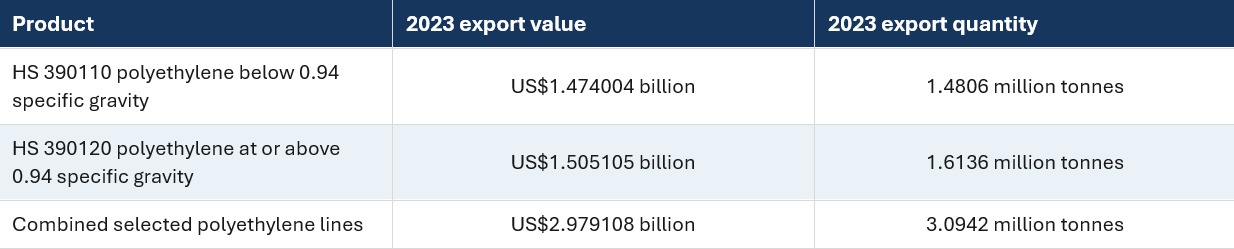
The 2024 WTO values and 2023 WITS figures come from different reporting systems and periods, so they should not be treated as a continuous price series. They do, however, point to the same conclusion: polyethylene is one of Iran’s most important non-oil export product groups.
Customs averages are historical trade indicators, not live resin quotations. They combine different grades, contract dates, volumes, destinations and Incoterms. A buyer should never convert the annual value and tonnage into a target purchase price without checking current market conditions and the exact grade.
Where Iranian polyethylene is sold
China was the largest destination for both major polyethylene lines in 2023. For HS 390110, Iran exported US$908.713 million and 948,632 tonnes to China. Iraq followed with US$168.354 million and 148,974 tonnes, while Türkiye purchased US$104.610 million and 99,845 tonnes. Afghanistan and Pakistan were also among the five leading destinations.
For HS 390120, China purchased US$857.669 million and 945,088 tonnes. India was the second-largest market at US$216.499 million and 230,043 tonnes, followed by Türkiye at US$154.989 million and 158,850 tonnes. Uzbekistan and Russia completed the top five.
This mix shows why Iran polyethylene exports appeal to two different buying groups. Large Asian markets absorb substantial bulk volumes, while nearby countries can benefit from shorter regional routes and more flexible land-based logistics.
Iran also imported selected polyethylene grades. In 2023, imports reached US$26.064 million for HS 390110 and US$38.950 million for HS 390120. Imports under HS 390190 were higher at US$41.656 million, compared with exports of US$8.959 million in that category. The pattern suggests that Iran is a strong net exporter of mainstream polyethylene while still buying certain specialty polymers, compounds or application-specific grades.
How to write a polyethylene enquiry that suppliers can answer
A message asking for “500 tonnes of HDPE” leaves too many questions unanswered. A useful request for quotation should include:
- Final application and processing method
- Required commercial grade or an approved equivalent
- Density range and test method
- Melt mass-flow rate with test temperature and load
- Mechanical properties relevant to the application
- Additive requirements such as UV stabilizer, antioxidant, slip or antiblock
- Colour, pellet appearance and contamination limits
- Food-contact, drinking-water, medical or other compliance requirements
- Trial quantity and expected annual demand
- Bag size, pallet preference and marking requirements
- Destination, preferred Incoterm and delivery schedule
If you already use a particular resin, share its technical data sheet rather than only the brand name. The supplier can then compare the important properties and explain where the proposed Iranian grade differs. For critical applications, “equivalent” should mean equivalent against agreed test values and processing results, not merely a similar marketing description.
Technical documents and tests that matter
The technical data sheet describes a typical grade. The certificate of analysis should report results for the actual batch or lot being shipped. Buyers often receive the first document and assume they have received the second; they serve different purposes.
At minimum, review melt flow, density, tensile properties, ash, volatile matter, colour and pellet condition where relevant. ISO 1133-1 covers determination of melt mass-flow rate and melt volume-flow rate under specified temperature and load conditions. ISO 1183-1 provides density methods for non-cellular plastics, while ISO 527-1 sets general principles for tensile testing. ASTM D1238 is also widely used for melt-flow testing, and ASTM D4976 provides a classification framework for polyethylene moulding and extrusion materials.
Application-specific tests may be more important than general resin data. Film buyers may need dart impact, tear, seal initiation, haze and coefficient of friction. Blow-moulding buyers may focus on swell, environmental stress cracking, impact and container drop performance. Pipe buyers should examine compound designation, carbon-black content and dispersion, oxidation induction time, slow-crack growth and hydrostatic strength.
ASTM D1693 can be used to assess environmental stress cracking of ethylene plastics, but its results depend on the test condition and sample history. As with any laboratory method, the contract should identify the exact standard, specimen preparation and acceptance criteria.

A production trial is still the best reality check
Paperwork can narrow the risk, but it cannot fully reproduce your production line. Screw design, temperature profile, output rate, die geometry, cooling and the percentage of recycled material can all affect processing.
Begin with a representative sample or trial lot. Record processing settings and compare output with the material already approved in your factory. During film production, check gauge stability, bubble behaviour, sealing and optical quality. Moulding applications require inspection of cycle time, surface finish, shrinkage and impact. When producing pipes, verify dimensions, extrusion stability and the required performance tests.
Once the trial proves successful, keep a sealed reference sample and use its lot details when approving the commercial order. This provides the buyer, supplier and inspector with a physical benchmark if a later shipment is disputed.
Food contact pipe and regulated applications
Compliance is determined by the destination and final use. A general statement that a polyethylene grade is “food grade” does not prove that a finished article complies with the buyer’s market.
For EU food-contact applications, buyers should review the declaration of compliance and supporting migration information under Commission Regulation EU No 10/2011, using the version applicable when the product is placed on the market. The consolidated text was updated on 14 July 2026.
Pipe applications require their own system standards. ISO 4427 covers polyethylene piping systems for water supply and pressure drainage or sewerage, with requirements extending beyond the resin pellet to compounds, pipe, fittings and joints. A resin used successfully in film or blow moulding is not automatically suitable for pressure pipe.
Ask suppliers to provide documents for the intended application and verify certificates with the issuing organization or relevant database. Regulations, positive lists and permitted uses can change, so market access should be checked before shipment rather than after arrival.
Pricing logistics and safe pellet handling
Polyethylene prices respond to ethylene and energy costs, plant operating rates, regional supply, grade availability, currency movements and freight. Offers should state the exact grade, quantity, Incoterm, packing, origin, delivery period and quotation validity.
Most polyethylene resin is shipped in 25-kilogram bags or larger flexible containers. Buyers should confirm bag construction, palletization, stretch wrapping, container lining where needed and protection from water, heat, puncture and contamination. Lot numbers on the bags should match the packing list and certificate of analysis.
Pellet loss is now a visible shipping issue. IMO recommendations for plastic pellets carried by sea call for strong packaging that prevents loss under normal transport conditions, clear cargo information and appropriate container stowage. In April 2026, the IMO agreed to develop a mandatory code for transporting plastic pellets in freight containers. Exporters and importers should therefore treat spill prevention as part of logistics planning, not simply warehouse housekeeping.
Checking an Iranian polyethylene supplier
The company sending the quotation may be a petrochemical producer, authorized distributor, independent trader or export intermediary. Ask which role it performs and whether the material will be supplied in original producer packaging.
Verify the legal identity of the seller, manufacturing source, grade availability, recent export experience and ability to provide traceable batch documents. Review bag photographs, markings and sample certificates before payment. For a first transaction, agree on sampling, independent inspection, document release and the procedure for handling an off-specification result.
Iran-related transactions may involve sanctions, banking, insurance, vessel and port restrictions. Buyers must screen the supplier, beneficial owners, banks, carrier and route under the laws applicable to their own business. Product availability does not by itself confirm that every transaction structure is permitted.
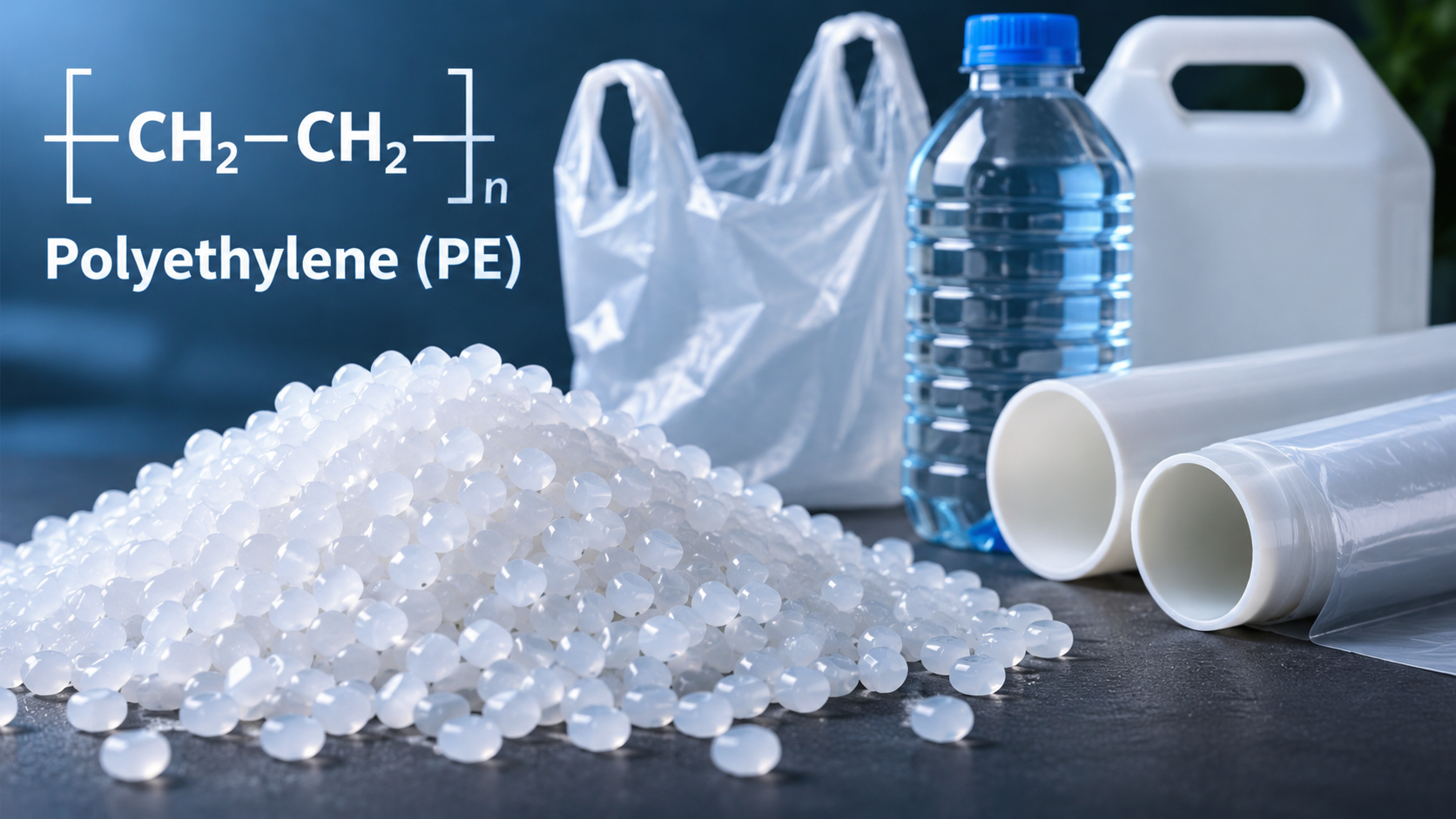
For international companies exploring Iran’s petrochemical industry, IXPORT provides a starting point for understanding the Iranian business environment and developing potential trade connections.
How IXPORT supports international polyethylene buyers
Finding a list of companies is only the first step. The real work is identifying which supplier can provide the correct grade, checking its role in the supply chain and keeping specifications, samples and documents consistent through the transaction.
NEXUS by IXPORT helps foreign buyers explore Iranian companies and build a more focused supplier shortlist. For projects that require local support, Iran Gateway can assist with market research, supplier verification, factory or warehouse checks, business matchmaking, document coordination and communication inside Iran.
When you contact IXPORT, send the application, grade or target data sheet, quantity, destination and preferred Incoterm. That gives us enough information to start a useful conversation with potential Iranian polyethylene suppliers.
Your next step
Are you looking for LDPE film resin, LLDPE for stretch film, an HDPE blow-moulding grade or a pipe compound with specific long-term performance? The answer changes the supplier, technical file, inspection plan and price comparison.
Share your buying brief with IXPORT. We can help turn a broad search for Iran polyethylene exports into a structured sourcing process based on the grade your production line actually needs.
Ready to source polyethylene from Iran? Contact the IXPORT team and share your required grade, technical specifications, order quantity and destination to discuss potential sourcing opportunities.
Sources and data notes
- WTO Iran trade profile and 2024 product values
- WITS Iran exports of HS 390110 in 2023
- WITS Iran exports of HS 390120 in 2023
- WITS Iran imports of HS 390110 in 2023
- WITS Iran imports of HS 390120 in 2023
- WITS Iran trade in other ethylene polymers HS 390190 in 2023
- ISO 17855-1 polyethylene designation system
- ISO 1133-1 melt-flow testing
- ISO 1183-1 density testing
- ISO 527-1 tensile testing
- ASTM D4976 polyethylene moulding and extrusion materials
- ASTM D1693 environmental stress cracking
- ISO 4427 polyethylene piping systems
- EU Regulation No 10/2011 consolidated to 14 July 2026
- IMO guidance on carriage of plastic pellets
16. NEXUS by IXPORT
17. Iran Gateway
Comments