

Buying Steel Wire from Iran with Confidence
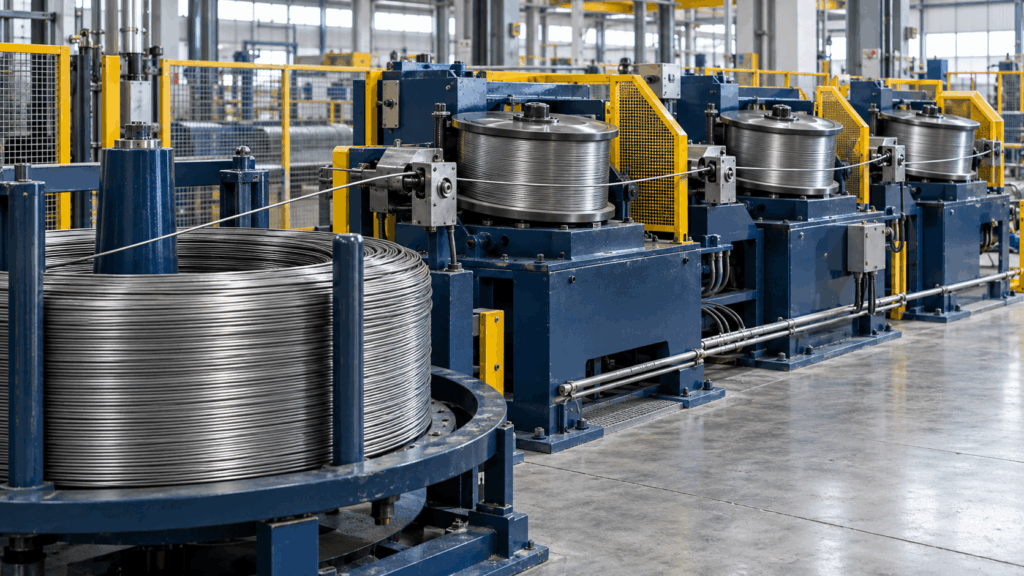
Buying Steel Wire from Iran with Confidence
Steel wire is rarely purchased for its appearance. It is purchased because it must be drawn, welded, galvanized, stranded, spring-formed or built into a product that cannot fail unexpectedly. That makes the right question more precise than “What is the price of wire per tonne?” The buyer needs to know which wire family is being offered, what process it can withstand and which evidence will support acceptance at the destination.
Iran is an active participant in international trade in iron and non-alloy steel wire. The market also includes imported wire products and upstream wire rod. This guide helps foreign importers, cable manufacturers, fastener producers, construction suppliers and industrial distributors connect technical requirements with a practical sourcing conversation.For a broader overview of the industry, explore our Iran iron and steel trade guide.
Separate wire rod from finished steel wire
Wire rod is a hot-rolled semi-finished product, usually supplied in coils, that becomes finished wire through drawing or other processing. Finished wire has been drawn, shaped, coated, welded or otherwise transformed for a defined use. The terms are related, but they should not be used interchangeably in an inquiry.
| Product family | Typical downstream use | Key buying question |
| Carbon steel wire rod | Drawing, mesh, nails, fasteners and general wire | Can the rod support the required reduction and surface quality? |
| Drawn low-carbon wire | Tying, mesh, fencing and general fabrication | What diameter tolerance and tensile range are required? |
| High-carbon wire | Springs, ropes and high-strength applications | Are chemistry, patenting and fatigue properties controlled? |
| Galvanized steel wire | Fencing, agricultural products and corrosion-exposed parts | What zinc coating mass and adhesion are specified? |
| Welding wire | Electrodes, wire mesh and welding consumables | Which welding classification, cleanliness and spool form apply? |
| Strand and wire rope | Prestressing, lifting, cranes and industrial service | What construction, breaking force and inspection standard apply? |
Stainless, alloy and low-carbon chromium wires form additional product groups. A steel service centre may sell several of these categories, while a wire mill may specialize in only one. Begin with the final product and work backward to the feedstock.
Choose the manufacturing route for the application
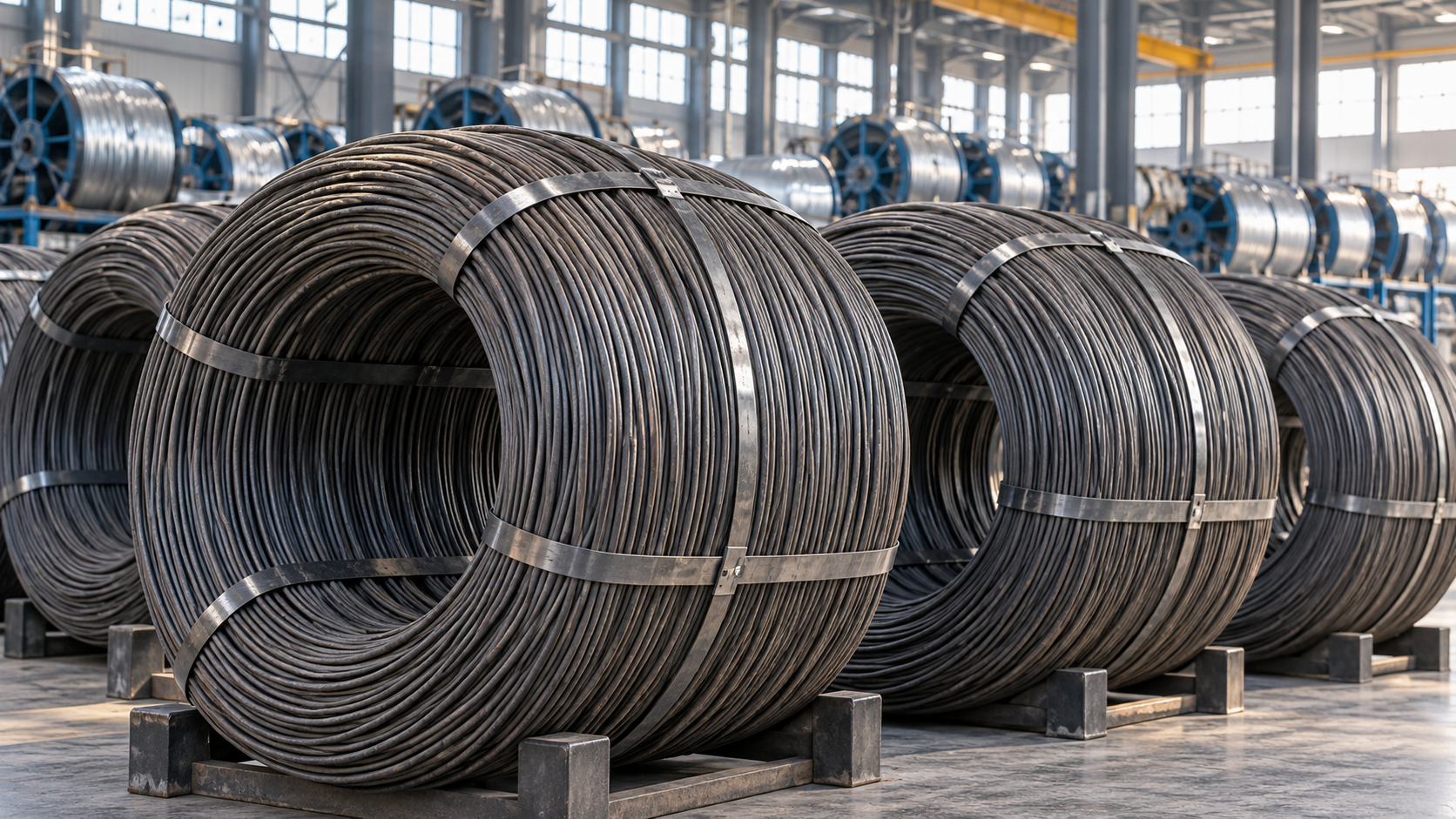
Wire rod quality starts at steelmaking and continues through rolling, cooling, coiling, drawing and finishing. Drawing reduces cross-section through a die and changes the wire’s strength, ductility and surface condition. Multiple passes may be required, with intermediate heat treatment or controlled lubrication depending on the grade and reduction.
Ask the supplier to state whether the offer is hot-rolled rod, drawn wire, annealed wire, galvanized wire, welded wire or stranded product. For wire rod, request the intended drawing route and maximum recommended reduction where relevant. For finished wire, state whether the order is for straight lengths, coils, spools, carrier reels or cut pieces.
The same nominal diameter can perform differently if its surface contains defects, its chemistry is unsuitable for drawing or its residual stresses are not controlled. A low price on a rod that breaks during drawing is an expensive purchase.
Read Iran’s wire trade data at the right level
World Bank WITS, using UN Comtrade data reported for calendar year 2023, records Iran’s exports of iron or non-alloy steel wire under HS 7217 at US$74.207 million and 112,025 tonnes. These are gross reported flows, not a measure of domestic production or current availability. [1]
| Iran wire trade snapshot | Value | Quantity |
| HS 7217 exports, 2023 | US$74.207 million | 112,025 tonnes |
| HS 7217 imports, 2023 | US$18.431 million | 18,274 tonnes |
| HS 721711 exports, 2023 | US$29.322 million | 50,340 tonnes |
| HS 731210 stranded wire and cable exports, 2023 | US$2.275 million | 1,195 tonnes |
HS 7217 covers wire of iron or non-alloy steel and includes several subcategories. The HS 721711 row is a narrower group for certain uncoated wire products, so it must not be added to the HS 7217 total. HS 731210 covers stranded wire, ropes and cables, which are downstream products rather than ordinary single wire. [1–4]
The apparent average export value for HS 7217 is approximately US$662 per tonne, calculated from the reported value and quantity. This is an aggregate statistical ratio, not an Iran steel wire price. It mixes product types, diameters, destinations, quality levels and trade terms. Do not use it as a quotation benchmark without matching the specification.
The data support a useful question for foreign buyers: are you seeking Iranian wire, Iranian wire rod for your own drawing line or a finished product such as strand and rope? Those are different supplier searches.
Match chemistry to the drawing and end use
Carbon content, manganese, silicon, sulfur, phosphorus and alloy additions affect drawing behaviour and final performance. A general low-carbon wire may be suitable for tying or fencing but not for a high-carbon spring or rope application. A welding wire requires chemistry and cleanliness appropriate to its classification, not merely a convenient diameter.
ASTM A510/A510M provides general requirements for carbon and alloy steel wire rods and coarse round wire. It is a starting specification, not a substitute for the complete application standard. State the required edition, grade, diameter, coil size, surface condition and test requirements. [5]
For galvanized carbon steel wire, ASTM A641/A641M addresses zinc-coated wire. The order should identify coating class or mass, coating adherence, wire diameter and mechanical properties. A galvanized appearance alone does not demonstrate compliance. [6]
For wire rope and stranded products, the construction must be specified: strand count, wire arrangement, core type, lay direction, nominal diameter, rope grade and breaking force. ISO 17893 defines vocabulary and classification for steel wire ropes, while ISO 10425 sets minimum requirements for ropes used in petroleum and natural gas industries. [7, 8]
If your requirement is a spring, prestressing wire, tire cord, bead wire or welding consumable, use the standard written for that product. A general wire certificate cannot replace a product-specific qualification.
Decide the delivery form before requesting a quote
Wire rod is commonly supplied in coils, while drawn wire may arrive in coils, compact carriers or spools. Galvanized wire may require protective wrapping to prevent damage and white rust. Welding wire can require controlled spool geometry, layer winding and clean packaging.
Specify coil or reel inside diameter, outside diameter, maximum mass, lifting points and whether the material must unwind without tangling. For automatic lines, pay attention to coil stability, welds between coils and the permitted number of coil breaks. If the material is to be decoiled or straightened, include the equipment and acceptance trial in the qualification plan.
| Delivery detail | Why it matters |
| Coil or reel mass | Determines crane, payoff and storage capacity |
| Inside and outside diameter | Controls payoff compatibility and transport planning |
| Welded coil joints | May interrupt automated drawing or mesh production |
| Surface protection | Reduces corrosion and coating damage during storage |
| Traceability labels | Connects material, heat, test report and customer order |
Ask whether the quoted mass is actual, theoretical or net of packaging. Agree how core, reel and wrapping weights are handled in settlement.
Control diameter, ovality and surface condition
Wire buyers should specify nominal diameter and permitted tolerance, not just a target measurement. Ovality can affect drawing dies, weld contact and final product geometry. For galvanized wire, measure the finished coated diameter according to the applicable method and keep the base-wire and coating requirements distinct.
Surface defects can become more serious as wire is reduced. Seams, laps, rolled-in scale, rust pits and scratches may cause breaks or visible defects in the final product. Define the inspection method, sampling frequency and permissible defect level. If the wire will be plated, welded or coated again, state the cleaning and surface requirements before that process.
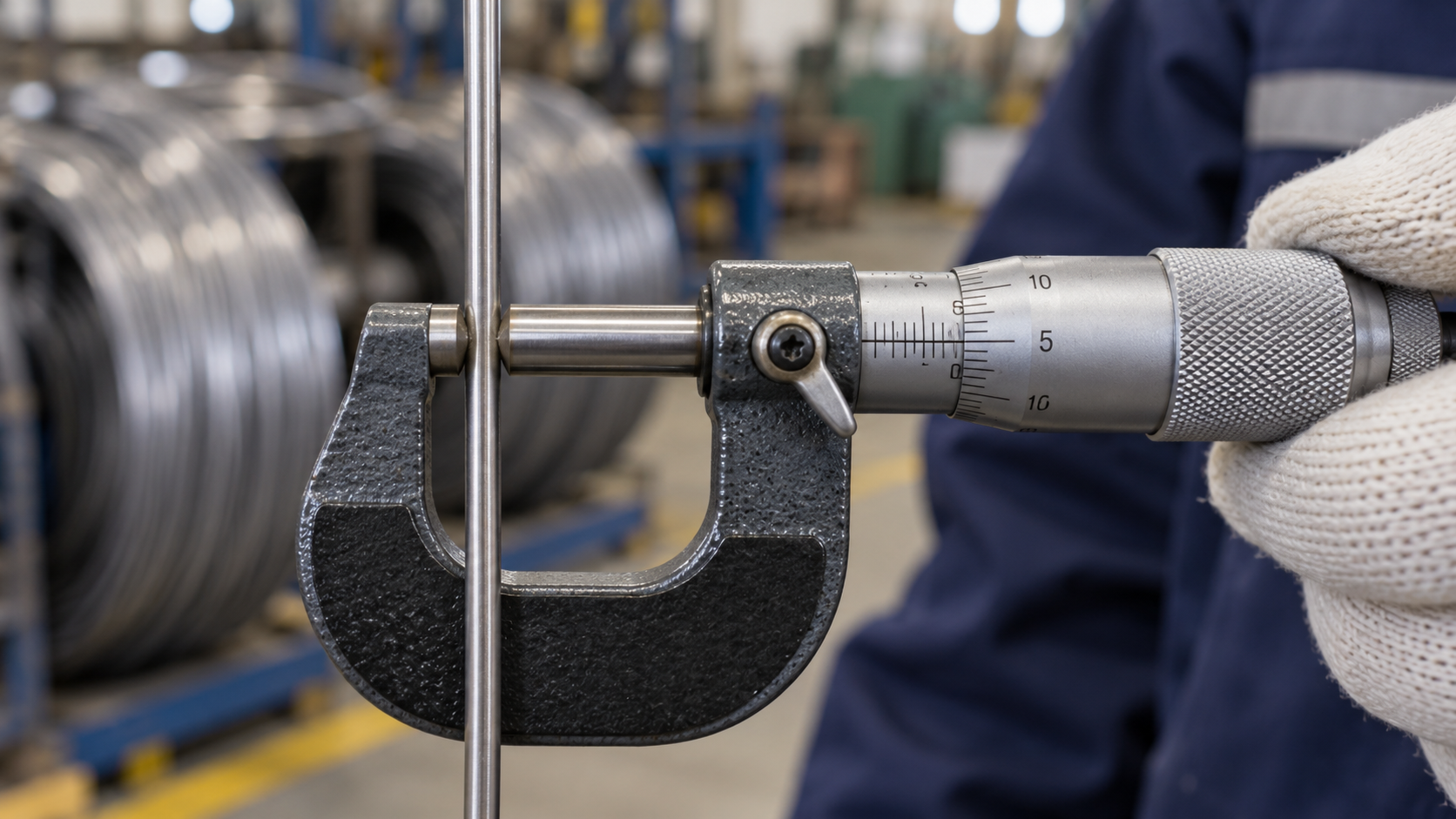
For high-strength products, tensile strength alone is incomplete. Elongation, torsion, reverse bend performance, fatigue behaviour and relaxation may matter to the application. The responsible engineer should identify the required tests and acceptance limits.
Compare the cost of usable output
The right cost comparison is the cost of accepted wire at the end of your process. A rod with a lower purchase price may create more breaks, die wear, scrap and downtime. A finished galvanized wire may cost more per tonne but eliminate a coating operation and reduce handling risk.
For a simple planning example, a 5.00 mm round wire has a theoretical cross-sectional area of approximately 19.635 mm². Using a steel density of 7,850 kg/m³ gives a mass of about 0.154 kg per metre, or 154 kg per 1,000 metres. The calculation is illustrative; use the governing standard’s mass and tolerance method for settlement.
Build landed cost from equivalent products: grade, diameter, tolerance, coating, package, inspection, freight, insurance, destination charges and duties. State the delivery point and Incoterms edition. For repeat supply, compare supplier consistency and delivery reliability alongside the nominal price.
Qualify the supplier and the actual production line
Request a capability statement for the exact combination of chemistry, diameter, package and finish. Confirm which facility will produce the goods. A trader may offer several origins, while a mill may have different lines for rod, drawing, galvanizing or rope. Use NEXUS by IXPORT to build an initial shortlist of steel businesses, then verify which companies can supply your required wire grade, diameter and finish.
For a first order, consider a sample coil or controlled production trial. Record the drawing die sequence, lubricant, reductions, annealing and final tests if the product is intended for your process. The trial should answer a purchasing question: does the material run at the required speed and produce acceptable output?
Ask for heat analysis, mechanical test results, dimensional data and coating measurements where applicable. Certificates should identify the supplied heat or production lot. Match coil tags, packing lists and test reports before release.
For wire rope, request construction details and breaking-force evidence. ISO 4309 provides principles for care, inspection and discard of ropes used on cranes and hoists; it is relevant to service management, not a substitute for the rope’s manufacturing specification. [9]
Plan transport, storage and claims
Wire coils and reels can be dense, unstable loads. Confirm lifting equipment, coil orientation, lashing and vehicle payload before dispatch. Protect bare and galvanized products from standing water and condensation. Store coils on suitable supports and keep labels readable.
Agree what happens if coils arrive wet, labels are missing, packaging is damaged or the material fails an agreed test. Define the inspection window, photographs and sampling procedure for a claim. Replacement freight and re-testing responsibilities should be written into the contract.
Confirm customs and transaction feasibility
HS 7217 is an indicative starting point for wire of iron or non-alloy steel. Coated wire, stainless wire, wire rope and products with additional processing may fall under different headings. Confirm the complete national tariff line, origin documents, duties and any trade remedies with a customs specialist. [1–4]
Trade involving Iranian iron and steel requires transaction-specific review. OFAC guidance identifies sanctions authorities concerning Iran’s iron and steel sectors and certain significant transactions, with possible exposure for non-US businesses. Review counterparties, beneficial ownership, payment channels, banks, insurance and transport before committing. [10]
Confirm current Iranian export requirements and the practical acceptance of the shipment by carriers and financial institutions. Technical compliance does not establish transaction clearance.
Find the right commercial partner in Iran
A wire rod mill, drawing plant, galvanizer, welding consumables producer and rope manufacturer solve different problems. IXPORT’s NEXUS B2B includes an industry-organized steel category to help overseas buyers build an initial shortlist. Verify each company’s current role, product range, certificates and production capability during qualification. [11]
For foreign suppliers seeking Iranian customers, Iran Gateway provides a Persian company presence and a channel for commercial inquiries. Describe the wire grades, equipment, coating or processing services you can actually provide so prospective partners can judge relevance. [12]
Tell IXPORT your target product, final application, standard, diameter range, annual quantity, packaging and delivery market. Are you importing steel wire from Iran, sourcing wire rod for a drawing operation or looking for Iranian buyers for a specialized product? A clear answer lets the next conversation move from a general catalogue to a workable opportunity.
Sources and data notes
[1] World Bank WITS, UN Comtrade, Iran HS 7217 exports, calendar 2023.
[2] WITS, Iran HS 7217 imports, calendar 2023.
[3] WITS, Iran HS 721711 exports, calendar 2023.
[4] WITS, Iran HS 731210 exports, calendar 2023.
[5] ASTM International, A510/A510M-25, wire rod and coarse round wire general requirements.
[6] ASTM International, A641/A641M-19R25, zinc-coated carbon steel wire.
[7] ISO 17893:2004, steel wire ropes vocabulary, designation and classification.
[8] ISO 10425:2023, steel wire ropes for petroleum and natural gas industries.
[9] ISO 4309:2017, crane wire rope care, maintenance, inspection and discard.
[10] US Treasury OFAC, FAQ 666, Executive Order 13871.
[11] IXPORT NEXUS B2B.
[12] IXPORT Iran Gateway.
Comments