

Buying Hot Rolled Steel from Iran: A Practical Guide
Buying Hot Rolled Steel from Iran: A Practical Guide
Two hot rolled coils can carry the same nominal thickness and still perform differently on a production line. One may feed smoothly through a tube mill; another may require extra trimming or levelling. For an importer, service centre or manufacturer, those differences affect the value of the purchase long after the steel has cleared customs.
Iran’s hot rolled steel trade offers a market worth investigating. Documented exports and imports show activity in both directions, creating questions for overseas buyers and suppliers alike. The useful starting point is your application: what must the steel do, which properties must be guaranteed, and what processing can your business handle? This guide connects those questions with specifications, trade figures and practical sourcing decisions.For a broader view of the industry, explore our Iran iron and steel trade guide.
Choose the delivery form around your production line
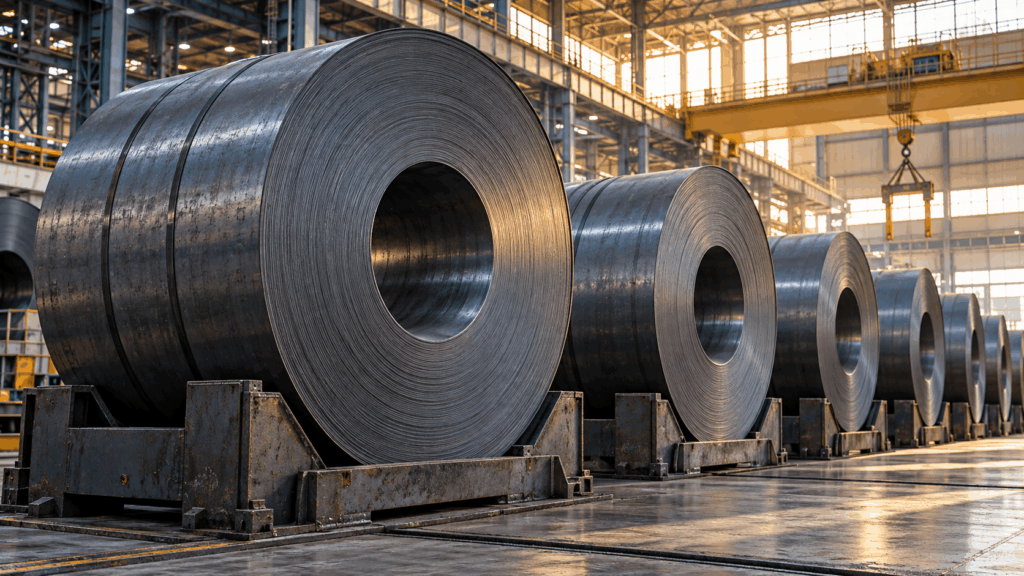
Hot rolling reduces steel at elevated temperature into flat products. Strip can be wound into hot rolled coil, commonly abbreviated HRC, or processed into sheets. A coil is a delivery form; it does not identify the steel grade, surface condition or suitability for an application. [1]
Buying full coils gives processors flexibility over cutting lengths and slit widths. It also requires suitable unloading, storage and processing equipment. Cut to length sheet shifts some of that work to the supplier or service centre and may suit fabricators purchasing defined blank sizes.
| Product or condition | What to clarify in the inquiry |
| Black hot rolled coil | Mill scale, surface acceptance and planned downstream cleaning |
| Pickled and oiled coil | Descaling, oil requirements and storage protection |
| Slit hot rolled strip | Finished width, burr limits, edge condition and coil winding |
| Cut to length hot rolled sheet | Length, squareness, flatness and bundle presentation |
| Patterned hot rolled sheet | Pattern specification, base thickness and mass basis |
Separately rolled heavy plate is another flat product category. Do not assume that a sheet cut from coil meets a heavy plate specification merely because its thickness is similar. The manufacturing route, required tests and delivery condition must match the order.To understand the upstream material used in hot rolling, read our guide to steel slabs from Iran.
Decide whether mill scale fits your process
Black hot rolled steel retains the oxide scale associated with hot processing. Pickling removes scale chemically; protective oil may then be applied. Hot rolled pickled and oiled steel, often called HRPO, therefore remains a hot rolled product. Pickling does not turn it into cold rolled steel. [1, 2]
For a buyer who already operates a suitable pickling line, black coil may be an appropriate feedstock. A fabricator needing a descaled surface may prefer HRPO. Establish what subsequent welding, painting, forming or coating requires, including cleaning before those operations.
Specify the supplied surface condition and acceptable defects rather than requesting “good surface quality.” Discuss scratches, rolled-in scale, pitting and edge damage in relation to the finished component. Agree inspection conditions and any permissible affected area. Oil provides temporary protection under agreed conditions; it should not be treated as a permanent corrosion coating.
What currently creates the most rework in your factory: surface preparation, edge trimming or sheet distortion? That answer can change which form of hot rolled steel is worth buying.
Read the Iranian trade figures at the right level
The Iranian Steel Producers Association’s table published by Chilan on 14 February 2026 records a substantial increase in the hot rolled sheet category. Its ten-month comparison covers Iranian years 1403 and 1404; the latter period runs approximately from March 2025 to January 2026. [3]
| Hot rolled export measure | Ten months of 1403 | Ten months of 1404 |
| Volume | 318,000 tonnes | 961,000 tonnes |
| Value | US$193 million | US$456 million |
The source reports volume growth of 203% and value growth of 136%, retaining its underlying rounding. The category is labelled hot rolled sheet and does not separately identify HRC and cut sheets. These figures describe that reported group, not a verified coil-only export total. [3]
A separate import table, published on 20 December 2025, provides the following eight-month comparison. [4]
| Hot rolled import measure | Eight months of 1403 | Eight months of 1404 |
| Volume | 358,000 tonnes | 190,000 tonnes |
| Value | US$266 million | US$165 million |
The reported declines are 47% in volume and 38% in value. Imports and exports cover different periods, so subtracting these tables would not produce a valid trade balance. Neither table establishes today’s HRC price, available grades or delivery capacity. [4]
For international businesses, the two-way trade raises a useful commercial question: which specifications connect your capabilities with Iranian demand or supply? An aggregate import figure cannot identify a shortage. Investigate grades, dimensions, end users and qualification requirements before treating it as a sales opportunity.
Select the grade through the finished application
Hot rolled steel is a family of materials. General fabrication, demanding forming and structural work may require different combinations of chemistry, strength and ductility.
For forming applications, the DD11 to DD14 family under EN 10111 is one reference point. Thyssenkrupp’s product guidance describes these low carbon grades for forming and drawing applications. The specific grade still needs to suit the part geometry and forming operation. [5]
Structural specifications such as EN 10025-2 address a different purchasing requirement. High strength grades for cold forming, including S355MC under EN 10149-2, offer another route. SSAB’s S355MC product example demonstrates why buyers need the full designation and delivery requirements, rather than a strength number alone. [6, 7]
ASTM A1011/A1011M covers several hot rolled sheet and strip categories, including carbon, structural and high strength steels. An order that says only “ASTM A1011” is therefore incomplete; identify the relevant designation and grade, applicable edition and supplementary requirements. [8]
These are international specification examples, not a catalogue of confirmed Iranian availability. Obtain a mill’s written capability statement for the exact combination of grade, thickness, width and condition you need. Have any proposed equivalence reviewed against the complete requirements.
Give specialist applications their own qualification
Tube and pipe manufacturers should define feedstock around the finished tube standard, welding process and intended service. A general structural coil is not automatically suitable for pressure service or line pipe. Chemistry, toughness and additional testing may become decisive.
For laser cutting, evaluate the material after processing as well as on delivery. ArcelorMittal’s guidance for its laser cutting steels links the resulting sheet flatness to appropriate uncoiling and levelling. A flatness requirement for cut sheet cannot simply be transferred to an unprocessed coil. [6]
For difficult bends or drawn parts, agree a representative production trial. Specify the part, tooling conditions and acceptance criteria so the trial answers a purchasing question. If the process succeeds, retain the qualified material description when moving from a sample to regular supply.
Define tolerances that your equipment can use
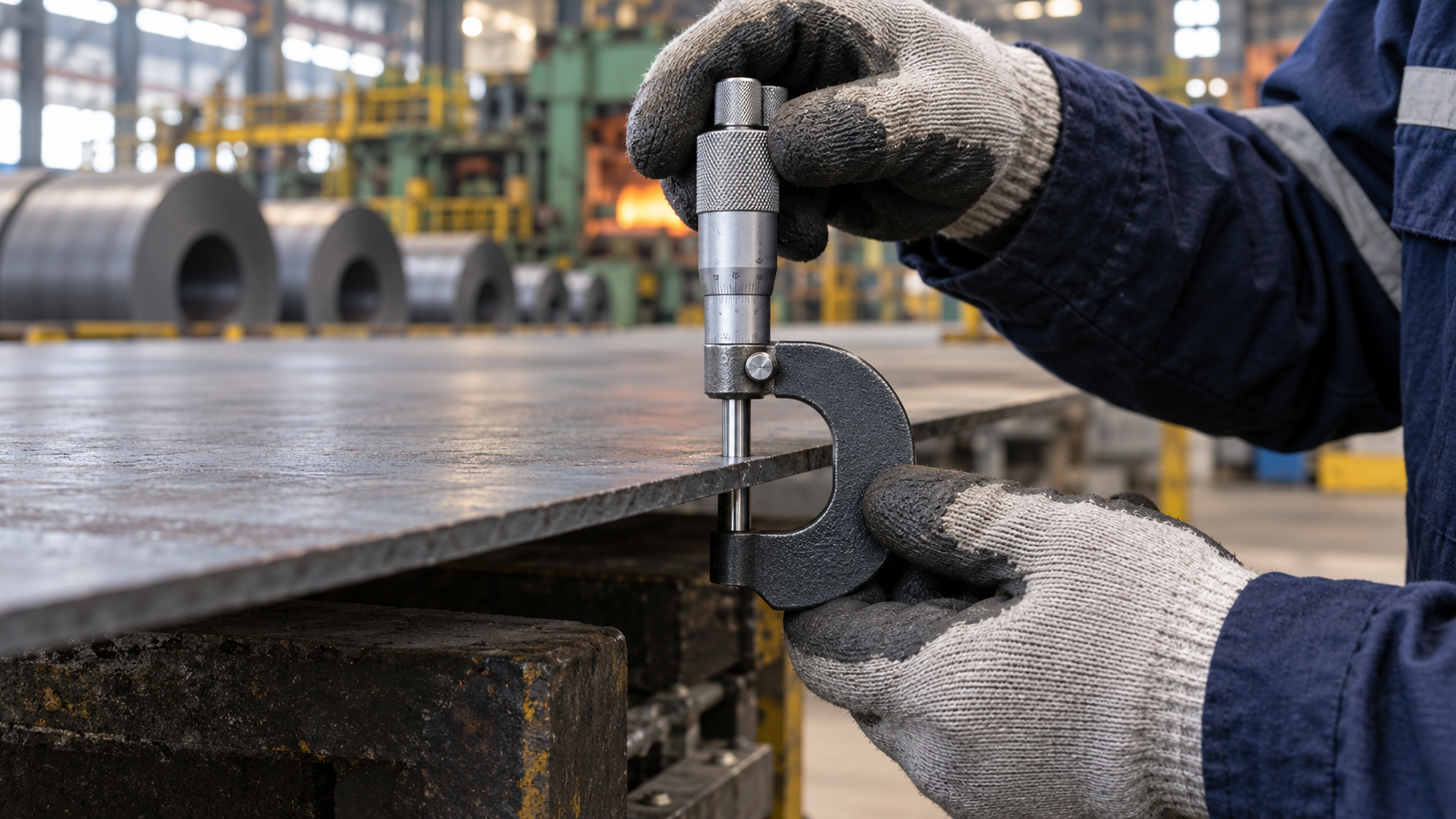
Nominal thickness and width are only the start. State the dimensional standard and edition, then identify tighter contractual limits where your process requires them. EN 10051 is a relevant reference for continuously hot rolled flat products, but tolerances must be selected for the applicable product and grade category. [6]
Ask about thickness variation along and across the strip, edge condition and camber, the sideways curvature of the strip. For sheet, specify flatness, length and squareness. Define how these characteristics will be measured and who performs the acceptance inspection.
Coil weight, inside diameter and maximum outside diameter must fit the uncoiler and lifting equipment. Include any minimum coil weight and restrictions on split coils. An attractive production lot becomes less useful if your line cannot handle its heaviest coil.
Avoid borrowing a dimension range from an unrelated mill’s catalogue. Confirm the proposed producer’s actual capability for your grade, including any restrictions at the thin, thick or wide ends of the range.
To build an initial shortlist of companies to contact, explore NEXUS by IXPORT, then confirm each supplier’s capabilities against your specifications.
Calculate usable steel before comparing quotations
HRC prices are usually discussed per tonne, while manufacturing output may depend on usable width, length or the number of accepted blanks. Connect those measures before choosing an offer.
Consider a hypothetical 25,000 kg coil measuring 3.0 mm thick and 1,250 mm wide. At an assumed density of 7,850 kg/m³, each metre weighs approximately 29.44 kg, giving a theoretical length of about 849 metres. Actual usable length will depend on delivered mass, dimensions and processing losses.
If the same coil requires trimming from 1,250 mm to 1,220 mm, the removed width represents 2.4% of the starting width, before end crops or rejected sections. That is a planning example, not a universal yield allowance. A different width or supplier-prepared edge may change the result.
Compare quotations with equivalent grade, surface condition, tolerances and delivery terms. Include slitting or levelling charges, inspection, transport and destination costs. Identify whether invoicing uses actual or theoretical mass and how tolerances affect settlement. Ask suppliers to separate optional processing from the basic steel price.
Keep coil identity through processing and resale
Request the required inspection certificate and confirm that it identifies the supplied material, heat and relevant test results. Match each coil label to the packing list and certificate before release. If traceability will be needed after slitting or cutting, agree how the parent coil identity transfers to the resulting bundles.
Inspection should address the order’s measurable requirements. It may include dimensions, surface condition, packaging, mechanical test evidence and additional tests specified for the application. Establish sampling, access for an independent inspector and the procedure for disputed results before shipment.
Clarify whether the offer is prime material, surplus stock or a product with declared deviations. For any non-prime offer, require the actual limitations in writing and assess them against the intended use. A lower price cannot answer an unresolved technical question.
Protect the material and the delivery programme
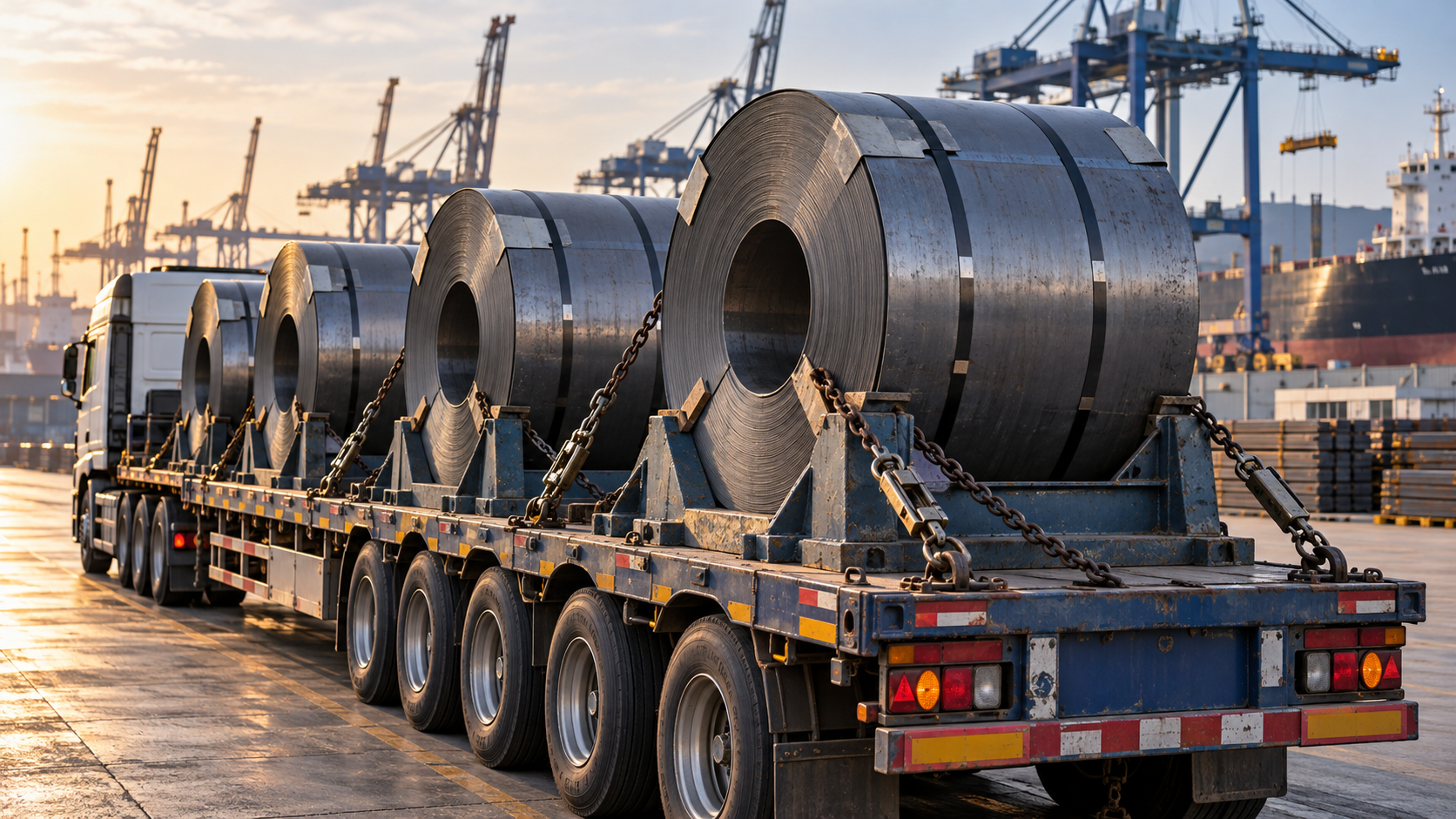
Confirm coil orientation, packaging, edge protection and handling arrangements with the supplier and carrier. Give the transport provider actual weights and dimensions, and verify the proposed loading and securing plan. Plan dry storage and appropriate moisture protection, especially for descaled material.
Agree shipment windows around your consumption rate and receiving capacity. For repeat purchases, ask whether the supplier can maintain the required grade and size mix across deliveries. Record how shortages, damage and quality claims will be documented, and allocate responsibility for replacement freight and delayed supply.
Confirm classification and transaction feasibility
HS heading 7208 covers qualifying hot rolled flat products of iron or non-alloy steel at least 600 mm wide, without cladding, plating or coating. Heading 7211 covers qualifying narrower non-alloy flat products; other headings apply to stainless or other alloy steels. Coil form, pickling and thickness can affect the subheading. Obtain the destination’s complete national tariff classification. [9]
Before commitment, confirm applicable import duties, trade remedies, approvals and Iranian export or import requirements. Sanctions also require transaction-specific review: OFAC identifies authorities concerning Iran’s iron and steel sectors and certain significant transactions, with potential exposure for non-US businesses. Check the parties and ownership, financing, bank acceptance, insurance and transport arrangements against all applicable rules. [10]
Connect your requirement with the right Iranian businesses
A mill, steel trader and service centre offer different capabilities. Identify which role your purchase needs, particularly where slitting, pickling or levelling is part of the requirement. IXPORT’s NEXUS B2B includes a steel category that can support an initial company shortlist. Verify each candidate’s current activities and capabilities before qualification. [11]
For foreign suppliers exploring Iranian customers, Iran Gateway provides a Persian company presence and a channel for business inquiries. Present the grades, processing services and documentation you can actually supply so potential partners can assess relevance. [12]
Tell IXPORT what you plan to manufacture or sell, your destination, required grade, dimensions, surface condition, quantity and delivery window. If one requirement remains uncertain, share that question too. Whether you need hot rolled coil suppliers in Iran or want to investigate Iranian buyers, a clear technical brief gives the first conversation a practical purpose.
Sources and data notes
[1] World Steel Association, Glossary, hot rolling and pickling terminology. Read source
[2] Thyssenkrupp Steel, hot strip product overview and pickled and unpickled supply conditions. Read source
[3] Iranian Steel Producers Association, ten-month 1403 and 1404 export table, published by Chilan on 14 February 2026. Hot rolled sheet row: volume 318 and 961 thousand tonnes; value US$193 and US$456 million. Reported growth percentages retain source rounding. Read source
[4] Iranian Steel Producers Association, eight-month 1403 and 1404 import table, published by Chilan on 20 December 2025. Hot rolled sheet row: volume 358 and 190 thousand tonnes; value US$266 and US$165 million. Read source
[5] Thyssenkrupp Materials Processing Europe, DD11 to DD14 product guidance under EN 10111. Read source
[6] ArcelorMittal, steel coils for laser cutting applications, A40 technical catalogue. Used for standards context and processing considerations, not proof of Iranian product availability or a general guarantee. Read source
[7] SSAB, Domex 355MC product information and S355MC specification context. Read source
[8] ASTM International, A1011/A1011M-25, public scope and abstract. Read source
[9] World Customs Organization, HS 2022, Chapter 72. Headings are indicative; confirm the full current national tariff line. Read source
[10] US Treasury OFAC, FAQ 666, Executive Order 13871. Read source
[11] IXPORT NEXUS B2B.
[12] IXPORT Iran Gateway.
Comments